


How to Clean Sofa Fabric Without Wrecking the Material

Quick Answer: Before cleaning a sofa, find the upholstery cleaning code, usually W, S, WS, or X, and follow the manufacturer's instructions. Test any cleaner in a hidden area, use as little moisture as necessary, blot instead of aggressively scrubbing, and stop if color transfers, texture changes, or a water ring begins forming. If the fabric is delicate, the code is unknown, or the sofa has widespread staining, professional cleaning may be safer than experimenting.
Cleaning sofa fabric the wrong way is surprisingly easy. A well-meaning homeowner grabs whatever cleaner is under the sink, saturates the stain, scrubs hard, and stands back, only to find a water ring where the stain used to be, or a texture that feels nothing like it did before.
The honest truth is that upholstery does not reward enthusiasm nearly as much as it rewards restraint. Safe sofa cleaning starts with identifying the fabric, reading the care code, using the right amount of moisture, and testing before treating anything visible. The biggest mistakes usually happen because someone used too much water, too much cleaner, too much scrubbing, or the wrong chemistry for that specific fabric.
This guide walks through the entire process, from finding the cleaning code to knowing when to call a professional instead of experimenting further.
Key Takeaways
Check the cleaning code first: Upholstery cleaning codes are one-letter care labels for furniture fabric: W means clean with water-based products, S means solvent-based cleaners only, W/S means either is safe, and X means vacuum or professional cleaning only. Treat this as your starting point before any product touches the fabric.
Over-wetting is the most common DIY mistake: Over-wetting a W-coded fabric is one of the most common DIY mistakes, even though the code technically allows water-based cleaning. More moisture does not mean more cleaning power on upholstery.
Natural fibers carry specific risks: Cellulosic browning occurs in natural fibers like cotton, linen, rayon, and jute. When they become overly wet and dry too slowly, natural sugars wick to the fabric surface and, as they oxidize, leave behind yellow or brown discoloration. Act accordingly if your sofa contains any of these materials.
Test in a hidden spot before treating a visible area: Wet fabric can look fine and still dry badly. Allow any test area to dry completely before deciding a cleaner is safe for the visible face fabric.
Dish soap and household cleaners carry residue risks: Dish soap is the most commonly recommended home remedy for many stains and does have surfactant action. The problem is residue: dish soap is formulated to be rinsed away thoroughly with running water, which is not possible on upholstery, and residue left in the fiber becomes sticky and attracts more soil.
Quick-Start Prioritization Framework
Strategy | Best For | Effort Level | Time to Results |
|---|---|---|---|
Find code + vacuum first | Every sofa, every time | Low | Immediate |
Spot test in hidden area | Before any product goes on fabric | Low | 20-40 min dry time |
Controlled blotting, fresh spill | Small, fresh W or WS-coded fabric | Low | Same day |
Upholstery-specific cleaner on W/WS fabric | Moderate surface staining | Medium | Hours |
Professional evaluation | Delicate fabric, unknown code, widespread soil, pet urine | Low effort from you | Scheduled |
Start here if you're:
Dealing with a small fresh spill on W-coded synthetic fabric: Blot immediately, check the code, test a cleaner in a hidden spot, apply a minimal amount, blot from outside in, and allow full drying before reassessing.
Facing an entire sofa that looks dingy or has dark armrests: Skip the DIY route. Widespread soiling, body-oil buildup, and multiple stains respond better to professional evaluation and appropriate extraction.
Unsure of the fabric or code: Slow down rather than guess. If the code is unknown, the fabric is unidentified, or a previous product was already used, professional evaluation is the lower-risk path.
First, Find the Upholstery Cleaning Code
The cleaning code is one of the most important pieces of information on the sofa. Cleaning codes are a voluntary labeling convention the furniture industry has used for decades so that owners do not ruin fabric with the wrong cleaner. Before reaching for any product, locate that tag.
W, Water-Based Methods Generally Allowed
W is the most common code on modern upholstery. W means the fabric can be cleaned with a water-based cleaning solution, and it is the most common and most forgiving code on modern upholstery. However, W does not mean soak it, over-wetting is a risk even on W-coded sofas.
S, Solvent-Based Cleaning Generally Required
S means solvent only, with no water. Water can leave rings, make the fabric shrink or stiffen, or move the dye, and the damage cannot be undone. A piece with this code needs a solvent-based cleaner.
WS / W-S, Either Method May Be Permitted
WS means water-based or solvent and either method is acceptable. It gives the most room to choose. Even so, WS does not mean any household product is acceptable, fiber type, dye stability, and manufacturer instructions still apply.
X, Vacuum or Specialty Care Only
X means vacuum or light brushing only, no water and no solvent. The fabric is too delicate for either, and the manufacturer expects the owner to vacuum it and live with what is left. Routine wet cleaning should be avoided on X-coded furniture.
Sofa Cleaning Codes Explained
Code | General Meaning | DIY Water-Based Cleaning? |
|---|---|---|
W | Water-based methods allowed | Often, with controlled moisture |
WS | Water or solvent methods | Possibly, still test first |
S | Solvent-based cleaning | Usually no |
X | Vacuum / specialty care | No routine wet cleaning |
The cleaning code is only a starting point. Factors like the age of the fabric, previous cleaning products that may have been used, the color stability of the dye, and the type of cushion filling all affect how the fabric will respond.
Where to Find the Cleaning Code
Before applying any cleaning product, water, or solvent to your furniture, locate the manufacturer's cleaning tag. Usually sewn beneath cushion zippers, attached to the inner lining under the sofa base, or tucked inside pillow casings, these letter codes indicate which cleaning agents are chemically compatible with your fabric. The tag may also be on the platform beneath removable seat cushions.
If no code is visible and the fabric cannot be identified, that is a good reason to slow down, not get more aggressive. Do not encourage guessing. An unidentified fabric treated with the wrong chemistry can sustain permanent damage that no follow-up treatment can reverse.
Vacuum Before You Add Any Cleaner
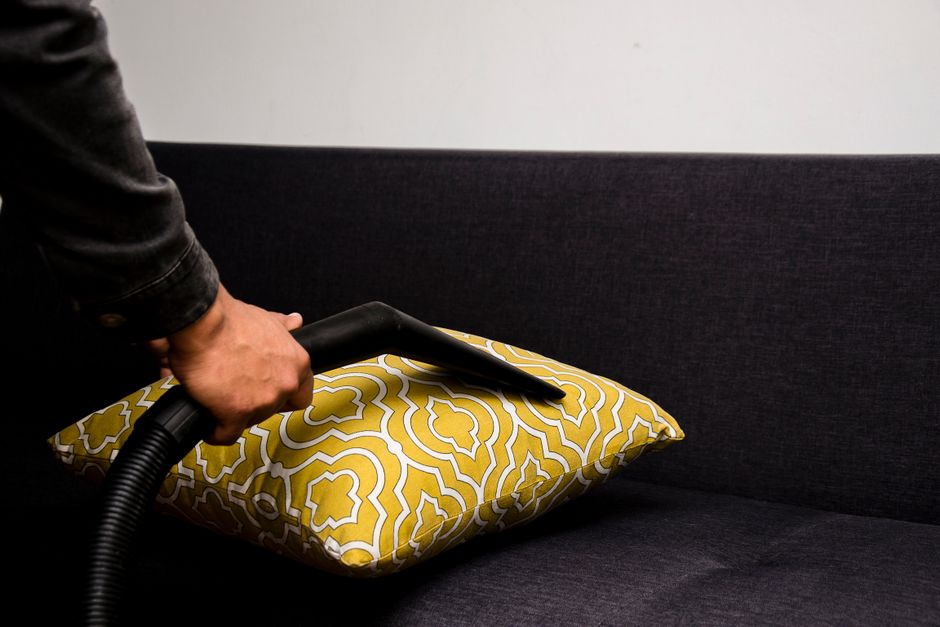
Always vacuum before moisture enters the picture. Removing dry soil first, hair, dust, crumbs, and loose debris from cushions, crevices, arms, the back, and under cushions, prevents loose particles from turning into muddy residue once any liquid is introduced. Use an upholstery attachment and work in multiple directions on fabric surfaces.
Pro Tip: Vacuuming is the one step that is never wrong, regardless of cleaning code. It applies to W, S, WS, and X-coded upholstery equally, and it sets up everything that comes next by removing the soil that would otherwise become a cleaning problem.
Test the Fabric Before Cleaning a Visible Area
Testing a hidden area is a non-negotiable step, even when the cleaning code is known. Apply a small amount of the intended cleaner to a concealed spot, typically under a cushion or low on the back, and check for color transfer, texture change, browning, water marking, or dye movement.
The critical rule: allow the test area to dry completely before concluding the cleaner is safe. The colorfastness test checks whether the dyes in the fabric will bleed or fade, and that answer is only visible once the fabric has fully dried. Wet fabric can look fine and still dry badly.
If color transfers to a white towel during testing, stop. As the IICRC S300 Standard for Professional Upholstery Cleaning makes clear, dye instability is a known risk factor that must be evaluated before cleaning proceeds. If the sofa is giving its color to the towel, the test has already answered the question.
Blot, Do Not Scrub
Do not scrub a spill. Scrubbing frays fabric fibers, spreads the liquid outward, and can work the stain farther into the upholstery. Instead, grab clean white towels or plain white paper towels and gently blot from the outside edge toward the center.
Aggressive scrubbing can also cause fiber distortion, pilling, fuzzing, and texture change that have nothing to do with the original stain. You are trying to lift the stain, not sand the sofa. Controlled blotting with gentle, targeted pressure is the right technique for most fabric upholstery situations.
Use Less Moisture Than You Think
A sofa contains more layers than its face fabric suggests, typically face fabric, backing, batting, foam, and internal padding. Excess water travels well beyond what the eye can see on the surface. Over-wetted cushions dry slowly and slow drying is where water rings, browning, and mildew happen.
This is where upholstery differs fundamentally from carpet. Carpet sits on a subfloor that can tolerate moisture and airflow in ways a closed cushion cannot. The inside of a sofa cushion may feel dry within hours on the surface while remaining damp internally for days.
What Too Much Moisture Can Do to Sofa Fabric
Problem | Possible Cause |
|---|---|
Water ring | Uneven wetting / drying |
Browning | Cellulosic fibers or backing material migration |
Odor | Slow-drying cushion interior |
Wicking | Soil or stain migrating back to surface as it dries |
Texture change | Over-wetting or aggressive agitation |
Dye bleed | Unstable dyes activated by moisture |
Why Water Rings Happen
Water rings form when one section of upholstery is wetted unevenly. Watermarks, also called "circling" or "rings," often appear around the area of a removed spot, frequently caused by residual soils or dissolved sizing. As the wet area dries, dissolved soil or cleaning residue migrates outward toward the drying edge, leaving an outline that is often more visible than the original stain.
This is why experienced professional cleaners often work an entire fabric section or panel rather than aggressively attacking a single small circle. Working just the stain creates a sharp moisture boundary at the edge. Working the full section gives soil and residue no sharp drying edge to migrate toward.
Why Some Sofa Fabrics Turn Brown After Cleaning
Browning after upholstery cleaning is a recognized problem with a specific name and cause. According to the IICRC S300 upholstery cleaning standard, browning, commonly called cellulosic browning, is a yellow, red, or brownish discoloration produced when the lignin in cellulosic or regenerated fibers is released in the presence of moisture, and it is caused by over-wetting or water damage, highly alkaline solutions, and prolonged drying.
The fibers most at risk are those derived from plants. Cellulosic browning occurs in natural fibers like cotton, linen, rayon, and jute. Browning does not happen on every natural-fiber sofa, but the risk is elevated when these materials get overly wet or dry slowly in humid conditions. Browning can appear hours after cleaning, which makes it particularly surprising. The sofa looked fine when it was wet.
Fabric Type Matters Too
The cleaning code and the fabric type are related but not the same thing. A W code on a linen sofa calls for different precautions than a W code on a polyester sofa. Synthetic upholstery is often more forgiving, while some natural and regenerated fibers require significantly more care.
Common Sofa Fabrics and Cleaning Cautions
Fabric | General Cleaning Consideration |
|---|---|
Polyester | Often more forgiving; still follow the cleaning code |
Microfiber | Cleaning code and fiber density still matter |
Cotton | Can be moisture-sensitive; browning risk if over-wet |
Linen | Can show rings or browning; highly absorbent |
Wool | Requires careful chemistry and moisture control |
Velvet | Construction varies significantly; use caution |
Viscose / Rayon | High risk for distortion and browning |
Blends | Treat according to the most sensitive component |
Natural fibers like cotton, linen and wool can shrink or brown if over-wet or treated with high-pH products, while rayon, viscose, and silk are prone to water rings and dye release. Always follow the furniture manufacturer's care instructions when available.
How to Handle a Fresh Spill
Speed helps, but speed without a plan can make things worse. Here are safe general steps for handling a fresh spill on W or compatible WS-coded upholstery:
Remove excess material, lift solids gently, blot liquids without pressing deep.
Blot gently from the outside edge toward the center with a clean white cloth.
Check the cleaning code before adding any product.
Test your chosen upholstery-specific cleaner in a hidden area.
Apply a small, controlled amount to the affected area only.
Blot from the outside edge toward the center again.
Allow the area to dry with good airflow before reassessing.
Reassess when completely dry, do not add more product while still damp.
Avoid chemical recipes. The specific fabric, dye stability, and stain type determine what will work, and no universal mixture accounts for all three.
How to Handle an Old Sofa Stain
Older stains are genuinely harder to address. Time allows oxidation to change the stain chemistry, previous products may have altered the fabric's surface, and heat from sunlight or sitting can effectively set some stains more deeply into the fiber. Set realistic expectations: some old stains improve significantly with professional cleaning, and some permanent changes to the dye or fiber itself cannot be reversed. A honest assessment before cleaning starts is better than a disappointed one after it ends.
Common Stain Situations
Coffee and Drink Stains
Coffee and drink stains are water-based, which means they are more approachable on W or WS-coded upholstery than oil-based stains. Blot as soon as possible, work from outside the stain toward the center, and use an upholstery-specific cleaner at the correct dilution. The risk with drinks that contain sugar is a sticky residue remaining in the fiber if not fully addressed. Avoid oversaturation, removing a coffee ring only to create a water ring is a common outcome of using too much moisture.
Grease and Body-Oil Stains
Armrests and headrests frequently show darkening from accumulated skin oils, hair products, lotion, and repeated body contact over months or years. A dark armrest is usually not one stain. It is months or years of repeated contact that has gradually built up in the fiber. This type of soiling typically requires broader treatment than a focused spot clean, and it often responds better to professional low-moisture extraction than to surface-level DIY attempts.
Pet Stains on a Sofa Are Different
Pet urine deserves its own consideration because it behaves differently from other spills. When a pet urinates on a sofa, the liquid does not stay at the fabric surface, and treatment applied to the fabric surface addresses only a small fraction of the actual deposit. Foam cushion filling acts as a sponge, absorbing and retaining urine deeply within its cell structure.
One pet accident may be a fabric problem. Repeated accidents can become a cushion problem. Surface cleaning may improve the visible appearance while odor remains in the foam below. DIY enzymatic treatment handles most fresh and moderately old pet accidents reasonably well, but once urine soaks into foam, spreads wide, or sits for months, a spray bottle often is not enough. Do not expect complete odor removal from a heavily saturated cushion through surface treatment alone.
Household Products That Can Create New Problems
Why Fragrance Is Not the Same as Cleaning
Fragrance changes the smell. Cleaning removes soil. Deodorizing addresses odor. Source treatment targets contaminated material. These are four different things, and a product that smells pleasant does not necessarily accomplish any of the last three. Perfume-style sprays applied to a stained sofa leave the stain in place behind a temporary scent.
Why Household Dish Soap Can Create Problems
Dish soap leaves a residue that rinses poorly and then attracts soil faster than before. Hydrogen peroxide is a mild bleach and can lighten dye on colored fabric. Neither is worth the risk on a good piece. Dish soap is built to be rinsed under a running tap, and a couch cannot be rinsed. A product that works well on a dinner plate is not automatically designed to rinse clean from sofa fabric.
Why Baking Soda Is Not a Universal Upholstery Cleaner
Dry baking soda is sometimes used for odor management on compatible surfaces, but it carries its own risks on upholstery. Powder can settle into seams and crevices, become difficult to fully remove, and interact with any moisture already present in the fabric. It is a targeted tool at best, and presenting it as a universal upholstery cleaner overstates what it can do.
Be Careful With Vinegar
Vinegar appears in many online DIY upholstery recipes. The concern is that acidity may not suit every fiber or dye, and vinegar does not address the specific chemistry of every stain type. Manufacturer care instructions should take priority over any household recipe. Water-based mixtures like a vinegar-and-dish-soap blend that works on some viscose and polyester weaves can cause rings, dye transfer, shrinkage, or backing damage on other textiles, which is why the tag code comes before any recipe.
Never Mix Random Cleaning Products
Combining cleaning products, especially bleach, ammonia, peroxide products, or multiple stain removers, creates unpredictable chemistry. If product number one did not work, turning the couch into a chemistry experiment is not step two. Apply one product at a time, assess when dry, and proceed cautiously from there.
Pro Tip: Always use a clean white cloth for blotting. Colored towels can transfer dye onto wet fabric, adding a color problem to whatever stain you were already managing.
How to Dry a Sofa Properly
Drying is as important as the cleaning itself. Promote airflow with a ceiling fan, HVAC circulation, or open windows. Where cushions have removable covers and the construction allows, opening them to allow interior airflow helps the foam dry from the inside rather than just on the surface. Avoid sitting on damp upholstery, pressure on a wet cushion redistributes moisture and can extend drying time significantly.
In a city like Atlanta, fabrics that are over-saturated during cleaning can take far longer to dry, raising the risk of mildew setting in before the piece has fully aired out. Proper airflow is particularly important during Atlanta summers when humidity can slow the drying process significantly. Avoid using heat sources to accelerate drying, heat can set residual staining and distort certain fibers.
DIY vs. Professional Cleaning: When Each Makes Sense
When DIY Sofa Cleaning Makes Sense
DIY may be reasonable when the cleaning code is W or compatible WS, the fabric is a durable synthetic, the stain is small, the stain is fresh, no dye transfer appears on the test cloth, and there is no deep odor present. Small fresh spills on everyday polyester or microfiber sofas are good candidates.
When Professional Upholstery Cleaning Makes More Sense
Recommend professional evaluation when the entire sofa looks dirty, armrests and headrests are dark from accumulated body oils, multiple stains exist, water rings are already present, pet urine has reached the cushion foam, the fabric is delicate, the cleaning code is unknown, the furniture is valuable, or previous DIY attempts have already caused rings or discoloration.
DIY Sofa Cleaning vs. Professional Cleaning
Situation | DIY May Be Reasonable | Professional Cleaning Better |
|---|---|---|
Small fresh spill | Yes | Usually not necessary |
W-code synthetic sofa | Often | If heavily soiled |
Entire sofa looks dirty | Limited | Yes |
Dark armrests from body oils | Limited | Often |
Pet urine reached cushion foam | Limited | Yes |
Water rings already present | Riskier | Yes |
Unknown cleaning code | No | Yes |
Viscose / fragile fabric | Riskier | Yes |
S or X code | No routine wet DIY | Specialty care |
What Atlanta Sofas Deal With
In Metro Atlanta, sofas face a specific combination of challenges that homeowners in drier or cooler climates do not encounter in the same way. Pollen gets tracked inside on shoes, clothing, and pets, and enters through doors, windows, and HVAC air intakes. Whether you are in a Smyrna ranch home, a Sandy Springs condo, a Vinings townhouse, or a Brookhaven bungalow, the combination of humidity, pets, kids, and a long pollen season means upholstered furniture in Metro Atlanta generally needs more frequent attention.
In a city like Atlanta, fabrics that are over-saturated during cleaning can take far longer to dry, raising the risk of mildew setting in before the piece has fully aired out. Communities like Marietta, Roswell, Alpharetta, and East Cobb are no exception. Add family room use, pets, and food and drinks to the equation, and the average Metro Atlanta sofa accumulates soil faster than most people realize until the fabric looks noticeably different.
How Dr Green Carpet Care Approaches Upholstery Cleaning
Dr Green Carpet Care begins with evaluation, not equipment. Before anything is applied to a sofa, the process typically includes inspecting the furniture, locating the cleaning code, identifying the fabric where possible, reviewing existing stains and any previous products used, testing dye stability, and then selecting an appropriate low-moisture or controlled extraction method and chemistry for that specific piece.
The approach is not one method applied to every sofa. The fabric type, construction, dye behavior, stain type, and moisture tolerance all factor into the cleaning decision. Sometimes the most professional cleaning decision is deciding not to clean a piece with the wrong method.
Pro Tip: Dr Green generally declines solvent-only (S-code) upholstery cleaning because it falls outside the company's eco-friendly cleaning model. If a sofa requires solvent-only care, Dr Green will say so and can point homeowners toward a qualified specialty provider rather than attempting something outside the right scope.
Dr Green Carpet Care approximate pricing for upholstery cleaning (pricing may vary based on size, fabric, condition, staining, and pet treatment, always confirm current pricing directly):
Armchair: around $60
Small recliner: around $65
Loveseat: approximately $99
Sofa: approximately $129
Small sectional: approximately $149
Large sectional: approximately $179
Dining chairs: approximately $10-$20 each
For current pricing and to discuss whether your specific sofa is a good candidate for professional cleaning, visit Dr Green Carpet Care's upholstery cleaning page.
Sofa Cleaning Checklist Before You Start
A clean, shareable reference before any DIY cleaning attempt:
Find the cleaning code
Identify the fabric if possible
Vacuum thoroughly, cushions, crevices, arms, back, and under cushions
Test a hidden area with the intended cleaner
Check for dye transfer on the test cloth, stop if color appears
Use an upholstery-specific cleaner at correct dilution
Use the minimum moisture necessary
Blot from outside the stain toward the center; do not scrub
Avoid mixing cleaning products
Allow full drying with good airflow before reassessing
Stop immediately if color or texture begins changing during cleaning
10 Sofa Cleaning Mistakes That Can Wreck the Fabric
Ignoring the cleaning code. Ignoring the cleaning code is one of the fastest ways to cause permanent damage: water rings, rough texture, color bleeding, or even a ruined piece of furniture.
Using too much water. Even W-coded sofas can develop browning, rings, and mildew from over-wetting.
Scrubbing aggressively. Scrubbing frays fibers, spreads stains, and distorts texture.
Skipping the test spot. A hidden-area test takes 20 minutes. Skipping it can cost a sofa.
Mixing cleaning products. Combining cleaners creates unpredictable and potentially damaging chemistry.
Saturating cushions. When water is poured on a stain it seeps through the fabric into the foam and eventually hits the wooden frame or metal springs.
Using water on S-code fabric. Water on an S fabric can create permanent rings and color changes that cannot be reversed.
Using too much soap. Excess detergent leaves residue that attracts further soil, and the couch cannot be rinsed the way a dish or floor can be.
Sitting on upholstery before it dries. Pressure on damp foam redistributes moisture and extends drying time significantly.
Continuing after color or texture changes. If the fabric begins responding poorly, stopping immediately limits the damage. Continuing always makes it worse.
Frequently Asked Questions
What is the safest way to clean sofa fabric?
Check the cleaning code label under or beneath the cushions first, then vacuum thoroughly to remove dry soil. Test any cleaner in a hidden area and allow it to dry completely before treating visible fabric. Use an upholstery-specific product at the correct dilution, apply with controlled moisture, blot from outside the stain inward, and allow full drying with good airflow.
What do W, S, WS, and X mean on a sofa tag?
Upholstery cleaning codes are the letters on a couch's care tag that tell you what the fabric can be cleaned with: W means water-based cleaners, S means water-free solvent only, WS (or SW) means either, and X means vacuum and light brushing only. These codes come from the furniture manufacturer and should be treated as the starting point, not the complete picture.
Can I use water on a fabric sofa?
Only if the cleaning code and manufacturer guidance allow it, typically W or WS codes on appropriate fabric types. Even then, use the minimum moisture necessary. A W-coded piece of furniture will usually perform better in a variety of environments, but a W code does not mean you can soak the furniture.
Why did my sofa get a water ring after I cleaned it?
Watermarks, also called rings often appear around the area of a removed spot, frequently caused by residual soils or dissolved sizing. Uneven wetting and drying allow dissolved soil or cleaning residue to migrate toward the drying edge. Working only a tight circle around the stain, rather than the full fabric section, is a common cause.
Should I scrub sofa stains?
Usually not. Aggressive scrubbing frays fabric fibers, spreads liquid further into the cushion, and can cause pilling, fuzzing, and permanent texture change. Gentle blotting with controlled pressure is the appropriate technique for most upholstery fabrics.
Can I use dish soap on a couch?
Dish soap is designed to be rinsed away under running water, which is impossible on upholstery. The residue left in the fibers keeps attracting soil, so the cushion often looks worse a few weeks later than it did before it was cleaned. Upholstery-specific products are a better choice.
Can pet urine be removed from a sofa?
Some surface staining and odor can improve, but urine that has penetrated deeply into cushion foam is a more complex problem. Once urine soaks into foam spreads wide, or sits for months, a spray bottle often is not enough. In cases of deep saturation, cushion foam replacement combined with professional fabric cleaning may be the most complete solution. No cleaning method can guarantee full odor removal from heavily contaminated foam.
When should I call a professional?
When the cleaning code is unknown, the sofa is heavily soiled or has widespread staining, the fabric is delicate or high-risk, pet contamination has reached the cushion interior, or previous DIY attempts have already produced water rings or discoloration. Dr Green Carpet Care provides professional upholstery cleaning throughout Metro Atlanta for appropriate fabric types and furniture, and evaluates each piece before choosing a cleaning method.
Cleaning sofa fabric safely is less about finding the strongest cleaner and more about matching the method to the material. Check the cleaning code, vacuum first, test before treating any visible area, control moisture carefully, blot instead of scrubbing, and stop if the fabric begins changing color or texture. If the sofa is heavily soiled, has pet contamination, already has water rings, or you simply do not know what the fabric can handle, Dr Green Carpet Care provides professional upholstery
Sources
Upholstery Cleaning Codes Explained: W, S, W/S, and X, Revolution Fabrics. Industry explanation of the four upholstery cleaning codes and what each permits. https://revolutionfabrics.com/blogs/gotcha-covered/upholstery-cleaning-codes-explained
Upholstery Cleaning Codes W, WS, S, and X Explained, BBC Marin. Detailed breakdown of cleaning codes including why the code is a starting point, not a finish line. https://www.bbcmarin.com/blog/upholstery-cleaning-codes-w-ws-s-x/
Upholstery Cleaning Codes Explained (W, S, WS, X), Allstate Cleaning. Covers code meanings, over-wetting risks, and dye stability considerations. https://allstatecleaning.com/upholstery-cleaning-codes-explained/
Couch Cleaning Codes: W, S, WS and X Explained, ODK Service. Practical guide to what each code permits and prohibits, including S-code water risks. https://www.odkservice.com/blog/couch-cleaning-codes-w-s-ws-x-explained
What Are Upholstery Cleaning Codes?, Rochester Carpet Care. Explains W, S, SW, and X codes with practical homeowner guidance. https://rochestercarpetcare.com/what-are-upholstery-cleaning-codes/
S300 Standard for Professional Upholstery Cleaning, IICRC. Industry standard covering cellulosic browning, dye stability, moisture risks, and professional cleaning protocols. https://iicrc.org/wp-content/uploads/2024/12/S300-Consolidated-Draft-Standard_Public-Review-and-CB-Approval_12202024.pdf
Consumer Floor and Furnishings Care Information, IICRC. Consumer-facing tip sheet covering cellulosic browning, natural fiber risks, and upholstery care guidance. https://iicrc.org/wp-content/uploads/2023/01/Tip-Sheet-Upholstery.pdf
What Is Cellulosic Browning? How to Treat It, Actichem. Technical explanation of cellulosic browning causes, affected fibers, and prevention measures. https://actichem.com.au/knowledge-centre/what-is-cellulosic-browning-how-to-treat-it/
Why Is My White Sofa Turning Yellow? Meet Cellulosic Browning, Mother Nature's Cleaning. Explains cellulosic browning causes including over-wetting, slow drying, and wicking from cushion interiors. https://www.mothernaturescleaning.com/blog/why-is-my-white-sofa-turning-yellow
How to Clean a Fabric Sofa Naturally, Biltrite Furniture. Covers safe DIY sofa cleaning including moisture control, code checking, and drying risks. Over-wetted cushions dry slowly
Sofa Cleaning Mistakes That Damage Your Furniture, Churchill Gulf. Covers common homeowner mistakes including ignoring cleaning codes, scrubbing, and using water on S-coded fabric. Colored towels can transfer dye
Upholstery Spill Treatment: What to Do First, Carpet and Tile Cleaning of Tulsa. Guidance on blotting technique, avoiding household cleaners, and when to call a professional. Do not scrub a spill
How to Get Grease Out of Upholstery, Bissell. Explains why dish soap creates residue problems on upholstery that cannot be rinsed away. https://www.bissell.com/en-us/blog/how-to-get-grease-out-of-upholstery/

Comments